
When it comes to measuring electrical signals, the first thing an electrical engineer might think of is an oscilloscope. An oscilloscope is an instrument that displays the law of voltage amplitude over time. It is equivalent to the eyes of an electrical engineer, allowing you to see the changes in current and voltage in the line, and thus master the working state of the circuit. But oscilloscopes are not an ideal tool for electromagnetic interference measurement and diagnosis.
A more suitable instrument for measuring electromagnetic interference is a Spectrum Analyzers. A spectrum analyzer is an instrument that displays the law of voltage amplitude as a function of frequency. The waveform displayed is called the spectrum. The spectrum analyzer overcomes the shortcomings of the oscilloscope in measuring electromagnetic interference, and it can accurately measure the interference intensity at each frequency.
The oscilloscope is not an ideal tool for electromagnetic interference measurement and diagnosis. This is because:
(1) The electromagnetic interference limit values in all electromagnetic compatibility standards are defined in the frequency domain, and the oscilloscope displays the time domain waveform. Therefore, the results of the test cannot be directly compared to the standard. In order to compare the test results with the standard, the time domain waveform must be transformed into the frequency domain spectrum.
(2) The electromagnetic interference is often small relative to the working signal of the circuit, and the frequency of electromagnetic interference is often higher than the signal, and when some low-frequency high-frequency signals are superimposed on a large amplitude low-frequency signal, The oscilloscope is unable to make measurements.
(3) The sensitivity of the oscilloscope is at the mV level, and the amplitude of the electromagnetic interference received by the antenna is usually V level, so the oscilloscope cannot meet the sensitivity requirement.
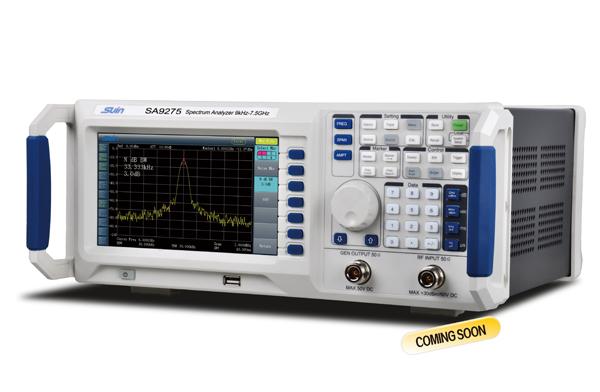
A more suitable instrument for measuring electromagnetic interference is a spectrum analyzer. A spectrum analyzer is an instrument that displays the law of voltage amplitude as a function of frequency. The waveform displayed is called the spectrum. The spectrum analyzer overcomes the shortcomings of the oscilloscope in measuring electromagnetic interference, and it can accurately measure the interference intensity at each frequency.
For the analysis of electromagnetic interference problems, spectrum analyzers are more useful instruments than oscilloscopes. The spectrum analyzer can directly display the various spectral components of the signal.
We supply Spectrum Analyzers. And we aslo supply Signal Generators. If you have demand, welcome to contact us.
Jul. 16, 2026
Power Quality Analyzer Buying Guide: How to Choose the Right ModelJun. 18, 2026
Dragon Boat Festival Holiday NoticeJun. 16, 2026
RF Signal Generator Selection Guide Based on Key Performance Specifications