News
Home - News-How to Set Up to Get the Best Sensitivity of The Spectrum Analyzer?

How to Set Up to Get the Best Sensitivity of The Spectrum Analyzer?

Feb. 25, 2019

When your Spectrum Analyzers cannot be shipped due to the electromagnetic interference emission intensity exceeding the electromagnetic compatibility standard, or when the system cannot work normally due to electromagnetic interference between circuit modules, we must solve the electromagnetic interference problem. To solve the electromagnetic interference problem, we must first be able to "see" the electromagnetic interference and understand the magnitude and source of the electromagnetic interference. This article will introduce methods for measuring electromagnetic interference and determining the source of interference.

 When it comes to measuring electrical signals, the first thing an electrical engineer might think of is an oscilloscope. An oscilloscope is an instrument that displays the law of voltage amplitude over time. It is equivalent to the eyes of an electrical engineer, allowing you to see the changes in current and voltage in the line, and thus master the working state of the circuit. But oscilloscopes are not an ideal tool for electromagnetic interference measurement and diagnosis. This is because:

A. The electromagnetic interference limit values in all electromagnetic compatibility standards are defined in the frequency domain, and the oscilloscope displays the time domain waveform. Therefore, the results of the test cannot be directly compared to the standard. In order to compare the test results with the standard, the time domain waveform must be transformed into the frequency domain spectrum.

B. The electromagnetic interference is often small relative to the working signal of the circuit, and the frequency of electromagnetic interference is often higher than the signal, and when some low-frequency high-frequency signals are superimposed on a large amplitude low-frequency signal, use an oscilloscope. It is impossible to make measurements.

Spectrum Analyzers Supplier

C. The sensitivity of the oscilloscope is at the mV level, and the amplitude of the electromagnetic interference received by the antenna is usually V level, so the oscilloscope cannot meet the sensitivity requirement.

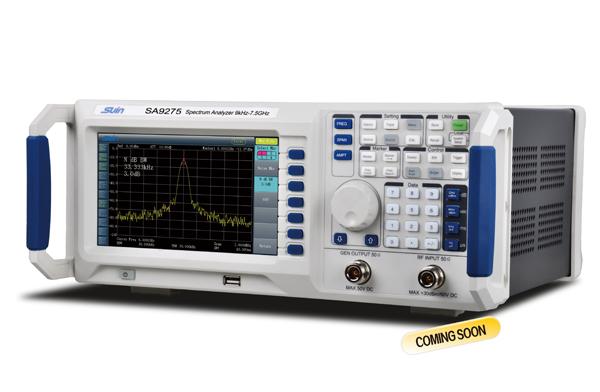
A more suitable instrument for measuring electromagnetic interference is a spectrum analyzer. A spectrum analyzer is an instrument that displays the law of voltage amplitude as a function of frequency. The waveform displayed is called the spectrum. The spectrum analyzer from Spectrum Analyzers Supplier overcomes the shortcomings of the oscilloscope in measuring electromagnetic interference, and it can accurately measure the interference intensity at each frequency.

For the analysis of electromagnetic interference problems, spectrum analyzers are more useful instruments than oscilloscopes. The spectrum analyzer can directly display the individual spectral components of the signal.

Latest News

Apr. 15, 2026

How RF Signal Generators Support 5G Network Development and Testing
Among the essential instruments used in RF laboratories and communication system testing environments, RF signal generators play a critical role. They provide stable, controllable, and highly accurate radio frequency signals that allow engineers to simulate real wireless environments and evaluate the performance of 5G base station hardware.
Learn More

Apr. 03, 2026

Suin Brings Innovation to HANNOVER MESSE 2026
Suin will attend HANNOVER MESSE on 20 ~24, April 2026, taking its new launched SA2110 Class S Power Quality Analyzer, SE3018 Multi-function Clamp Earth Resistance Tester, and its high accuracy SA2200 Class A Power Quality Analyzer, economical type SA2300 Three Phase Power Analyzer. Welcome to visit G54-5 Booth, Hall 12 to explore our innovations!
Learn More

Mar. 19, 2026

Class A Power Quality Analyzer Working Principle and Applications
A Class A Power Quality Analyzer is designed to accurately monitor and evaluate these power quality parameters according to internationally recognized standards IEC61000-4-30. These instruments provide reliable data for diagnosing power system problems and improving energy efficiency.
Learn More