
When it comes to measuring electrical signals, most electrical engineers initially think of an oscilloscope. An oscilloscope is a vital instrument that visualizes voltage amplitude over time, making it indispensable for diagnosing circuit behavior. However, when dealing with electromagnetic interference (EMI) measurement and diagnosis, oscilloscopes have significant limitations.
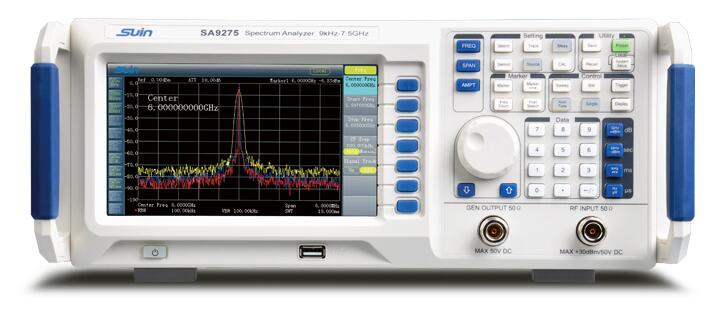
Suin's spectrum analyzer
For precise EMI analysis, a spectrum analyzer is the preferred instrument. Unlike oscilloscopes, which operate in the time domain, spectrum analyzers provide a frequency-domain representation of signals, making them ideal for identifying and measuring interference sources.
While oscilloscopes are invaluable for time-domain analysis, they fall short in electromagnetic interference applications due to the following reasons:
1. Electromagnetic Compatibility Standards Are Defined in the Frequency Domain
All major electromagnetic compatibility (EMC) standards specify interference limits in terms of frequency. Since oscilloscopes display signals in the time domain, their measurements cannot be directly compared with EMC standards. To achieve compliance testing, engineers would need to convert time-domain signals into frequency-domain spectra, an additional step that a spectrum analyzer inherently eliminates.
2. Inability to Measure Small EMI Signals Amid High-Power Circuit Signals
EMI signals are often weak compared to operational signals in a circuit. Moreover, EMI frequencies are typically higher than standard signal frequencies. When low-frequency signals with large amplitudes are superimposed on high-frequency interference signals, oscilloscopes lack the resolution to isolate and measure these interferences effectively.
3. Sensitivity Limitations
Most oscilloscopes have a sensitivity range in the millivolt (mV) level, while the amplitude of EMI signals received via an antenna is typically in the volt (V) range. This discrepancy prevents oscilloscopes from accurately detecting small EMI variations. In contrast, spectrum analyzers offer superior sensitivity levels, making them better suited for precise EMI analysis.
A spectrum analyzer is an instrument that displays signal amplitude as a function of frequency, revealing the spectral composition of electrical signals. By directly measuring interference intensity at each frequency, spectrum analyzers overcome the limitations of oscilloscopes in EMI detection.
Real-Time Frequency-Domain Analysis: Spectrum analyzers instantly show EMI levels across the frequency spectrum, eliminating the need for complex transformations.
High Sensitivity and Accuracy: Unlike oscilloscopes, spectrum analyzers detect weak signals that would otherwise go unnoticed.
Ability to Identify Specific Interference Sources: Engineers can isolate and diagnose EMI problems more effectively.
Compliance Testing Compatibility: Measurements from spectrum analyzers can be directly compared with international EMC standards, such as CISPR, FCC, and EN guidelines.
Aerospace & Defense: Detecting signal interference in communication and radar systems.
Automotive Electronics: Ensuring compliance with EMC regulations in vehicle electronics.
Medical Devices: Preventing unintended interference in sensitive diagnostic and therapeutic equipment.
Wireless Communications: Identifying and troubleshooting frequency interferences in telecom networks.
According to recent market research, the global spectrum analyzer market is projected to grow at a CAGR of 6.2% from 2024 to 2030, driven by increasing demand for wireless technology, 5G networks, and IoT applications. The rise in EMC testing requirements across industries is also fueling demand for high-precision spectrum analyzers.
At SUIN, we specialize in high-performance spectrum analyzers and signal generators, designed for precise EMI testing and compliance verification. Our advanced instruments deliver unmatched accuracy, reliability, and ease of use, making them the preferred choice for engineers and researchers worldwide.
SUIN Spectrum Analyzer Features:
✔ Wide Frequency Range: Covering from 9 kHz to 7.5 GHz, suitable for various applications.
✔ High Dynamic Range & Sensitivity: Ideal for detecting low-level signals.
✔ User-Friendly Interface: Advanced software for intuitive data analysis.
✔ Industry Compliance: Meeting global EMC and RF measurement standards.
Are you looking for top-tier spectrum analyzers to enhance your EMI measurement capabilities? SUIN offers cutting-edge solutions for industries requiring precise signal analysis. Contact us today for product details, pricing, and expert consultation.
With SUIN's advanced spectrum analyzers, gain the power to detect, diagnose, and resolve electromagnetic interference efficiently!
Jul. 16, 2026
Power Quality Analyzer Buying Guide: How to Choose the Right ModelJun. 18, 2026
Dragon Boat Festival Holiday NoticeJun. 16, 2026
RF Signal Generator Selection Guide Based on Key Performance Specifications